
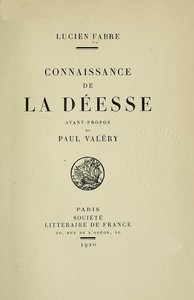
Connaissance de la Déesse by Lucien Fabre
First things first: this isn't your typical page-turner. Lucien Fabre's Connaissance de la Déesse (which translates to 'Knowledge of the Goddess') is a dense, lyrical, and deeply introspective work. It feels less like a story you watch unfold and more like a psyche you step inside.
The Story
The plot, in a conventional sense, is thin. An unnamed narrator is completely consumed by his fixation on a woman he elevates to the status of a goddess. We follow his internal monologue as he tries to dissect his feelings, analyze her every gesture and word, and ultimately, achieve some kind of perfect understanding of her essence. The 'action' is all mental: memories of encounters, philosophical musings on love and beauty, and desperate attempts to pin down the elusive nature of his idol. The central question hangs over every page: will he ever truly know her, or is she destined to remain an enchanting, frustrating mystery?
Why You Should Read It
I'll be honest, this book requires patience. But if you give it that, it's incredibly rewarding. Fabre's writing is gorgeous and intense. He packs so much thought into every sentence. Reading it feels like uncovering a secret diary from the 1920s French intellectual scene. The narrator's obsession is uncomfortable and fascinating in equal measure. It made me think about how we idealize people, turning them into symbols that serve our own needs rather than seeing them as complex individuals. Is the 'Goddess' even a real person, or is she just a mirror for the narrator's own mind? The book doesn't give easy answers, and I love that.
Final Verdict
This book is not for everyone. If you want a fast plot and clear characters, look elsewhere. But if you're in the mood for something different—a piece of literary history that's more of a philosophical tone poem than a novel—please pick this up. It's perfect for readers who enjoy Virginia Woolf's stream-of-consciousness, the poetic puzzles of Rainer Maria Rilke, or anyone who likes to wrestle with big questions about love, perception, and art. Think of it as a brainy, beautiful, and sometimes bewildering artifact from another time, waiting to be rediscovered.
This masterpiece is free from copyright limitations. It serves as a testament to our shared literary heritage.
David Brown
4 months agoI was particularly interested in the case studies mentioned here, it addresses the common misconceptions in a very professional manner. The insights gained here are worth every minute of reading.
Joseph Miller
1 month agoIt took me a while to process the complex ideas here, but the practical checklists included are a great touch for real-world use. A trustworthy resource that I'll keep in my digital library.
Karen Wilson
5 months agoThe peer-reviewed feel of this content gives me great confidence.
David Thomas
11 months agoHaving read the author's previous works, the attention to detail regarding the core terminology is flawless. I'm glad I chose this over the other alternatives.








Jennifer Rodriguez
10 months agoAs a professional in this niche, the inclusion of diverse viewpoints strengthens the overall narrative. I’ll definitely be revisiting some of these chapters again soon.