
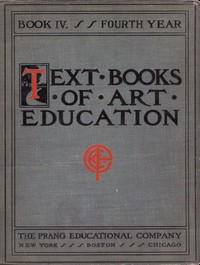
Text books of art education, v. 4 of 7. Book IV, Fourth Year by Froehlich and Snow
Let's be clear from the start: this is not a storybook. Published in 1905 as part of a seven-volume series, Book IV is a teacher's manual and student guide for fourth-year art education. It lays out a full year's curriculum. The 'plot' is the progression of lessons. It starts with foundational review—mixing colors, understanding tints and shades—and then builds through increasingly complex tasks.
The Story
The book's structure is its narrative. Students begin by drawing simple geometric forms and patterns. They learn 'conventional' ways to draw leaves and flowers, not from life, but from established design principles. They practice border designs, work on symmetry, and are taught to illustrate objects like baskets and vases with careful attention to outline and proportion. The final 'chapters' involve applying these skills to create more complete pictures, like a still life or a decorative design. There are no characters, only the implied student and the very prescriptive teacher-author guiding every pencil stroke. The drama is in the precision demanded; creativity is funneled through strict technique.
Why You Should Read It
I found this book utterly absorbing for what it reveals. It's a direct line to the educational philosophy of 1905. Art here is a discipline, akin to penmanship or arithmetic. The goal isn't primarily self-expression but training the eye and hand for good taste and industrial design. Reading it, you feel the weight of a different set of cultural values: order, reproducibility, and a specific ideal of beauty. It's fascinating to contrast this with modern art education, which often prioritizes personal vision and experimentation. This manual shows a world where every child was taught to see and draw in the same 'correct' way. It makes you wonder about the lost skills of careful drafting and the gained freedom of creative chaos.
Final Verdict
This is a niche but rewarding read. It's perfect for history buffs, educators, and artists curious about the roots of their field. If you enjoy social history or have ever wondered 'what did kids actually learn in school 100 years ago?', this book provides a concrete, page-by-page answer. It's not for someone looking for a gripping tale, but for a thinker interested in the silent, powerful ways a society shapes its young minds. As a peek into a vanished classroom, it's a quiet little masterpiece of historical context.
This digital edition is based on a public domain text. Feel free to use it for personal or commercial purposes.
Donald Rodriguez
1 year agoImpressive quality for a digital edition.
Paul Johnson
5 months agoI found the author's tone to be very professional yet accessible, the breakdown of complex theories into digestible segments is masterfully done. The price-to-value ratio here is simply unbeatable.
Linda Smith
10 months agoThe methodology used in this work is academically sound.
James Martin
1 month agoI appreciate the objective tone and the evidence-based approach.







Charles Thomas
1 month agoThe research depth is palpable from the very first chapter.