
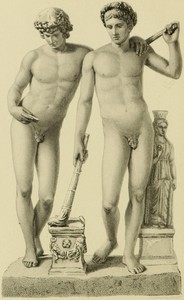
Sketches and Studies in Italy and Greece, Complete by John Addington Symonds
Forget the dry history lecture. ‘Sketches and Studies in Italy and Greece’ is something much more personal. John Addington Symonds published these pieces over many years, collecting his thoughts from countless journeys. There isn't a single plot in the traditional sense. Instead, the ‘story’ is Symonds’s own intellectual and emotional journey as he explores the physical and cultural landscapes of the Mediterranean.
The Story
Think of it as a series of deeply observed postcards from a lost world. Symonds walks us through Venice’s watery streets, the sun-baked hills of Tuscany, and the stark, beautiful ruins of Greece. But he’s never just a tourist pointing out sights. He’s a detective of culture. His central quest is to understand the Renaissance—that phenomenal period of human achievement—and to trace its echoes and its decay. He looks at a statue by Michelangelo and wonders about the man’s struggles. He visits a forgotten monastery and puzzles over how such vibrant art could come from a place of quiet devotion. The ‘conflict’ is between the glorious past he admires and the quieter, sometimes disappointing present he observes. The book is his attempt to bridge that gap.
Why You Should Read It
I keep returning to this book because of Symonds’s voice. He writes with a warmth and clarity that pulls you right in. You feel his awe in front of a Greek temple and share his frustration when a beautiful fresco is crumbling away. He’s brilliant at connecting art to the life that created it. He doesn’t just describe a painting’s colors; he talks about the society that paid for it, the artist’s hopes, and the ideas it represents. For me, the most powerful theme is memory—how places hold memories, and how fragile our connection to history really is. He makes you see that these aren’t just old stones; they’re chapters in the long story of human creativity.
Final Verdict
This is a perfect book for a certain kind of reader. If you love travel writing that goes deeper than restaurant recommendations, you’ll find a treasure here. It’s ideal for art lovers who want context beyond the museum placard, and for anyone who enjoys thoughtful, elegant prose. It’s not a fast-paced adventure; it’s a slow, reflective stroll. Pour a coffee, settle into a comfortable chair, and let Symonds be your guide to the heart of the Renaissance. You’ll come away seeing the world—and its history—with new eyes.
This title is part of the public domain archive. Share knowledge freely with the world.
Charles White
1 year agoThe digital formatting makes it very easy to navigate.
William Lewis
7 months agoFinally found time to read this!
Donna Walker
2 years agoCompatible with my e-reader, thanks.









George Thompson
8 months agoExactly what I was looking for, thanks!