
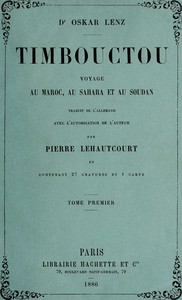
Timbouctou, voyage au Maroc au Sahara et au Soudan, Tome 1 (de 2) by Oskar Lenz
Published in the 1880s, this is the first-hand account of Oskar Lenz's 1879-1880 expedition from Morocco, across the vast emptiness of the Sahara, and into the western Sudan. He wasn't a tourist; he was a scientist on a mission for the Austrian Geographical Society, disguised as a Muslim merchant for safety. The 'story' is his day-to-day struggle for survival and knowledge.
The Story
Volume One kicks off in Tangier, Morocco. Lenz doesn't just jump into the desert. He spends months preparing—learning customs, hiring guides, and assembling a caravan. The real journey begins as he leaves the last outposts of the Moroccan empire behind. The plot is driven by obstacles: navigating by stars, finding hidden wells, dealing with suspicious local rulers, and the mind-numbing monotony of the desert itself. The central 'character,' in a way, is the Sahara. It's a hostile, beautiful, and deceptive landscape that tests him constantly. The narrative builds toward his arrival in Timbuktu, a moment charged with centuries of European fascination, which happens at the end of this volume.
Why You Should Read It
Forget romanticized desert tales. Lenz's writing is blunt, observant, and often funny in a dry, exhausted way. His focus is on practical details—how much water costs, what the camels ate, the strange rock formations he sketched. This practicality makes the adventure feel real. You're not reading a legend; you're reading a logistics report from the edge of the world. What grabbed me was his changing perspective. He starts with a European's confidence but slowly reveals a deep respect for the nomadic Tuareg and the complex trade networks that made life in the desert possible. His prejudices are there (it's a product of its time), but so is his genuine curiosity.
Final Verdict
This book is perfect for history buffs and armchair adventurers who want the gritty, unvarnished truth of 19th-century exploration. It's not a fast-paced thriller, but a slow-burn immersion into a world defined by sand, sky, and survival. If you enjoy primary sources that let you draw your own conclusions, and if you've ever looked at a map and wondered, 'How on earth did someone first walk across that?', then Lenz's journey is an unforgettable answer. Be ready for a thoughtful, demanding, and ultimately rewarding trek.
This historical work is free of copyright protections. Share knowledge freely with the world.
Joseph White
1 year agoSolid story.









Joshua Wilson
1 year agoThe index links actually work, which is rare!