
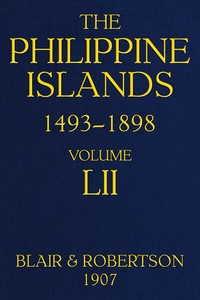
The Philippine Islands, 1493-1898, Volume 52, 1841-1898 by Emma Helen Blair et al.
Let's be clear from the start: this isn't a novel. The Philippine Islands, 1493-1898, Volume 52 is a curated archive. Think of it as a time capsule. The editors, Emma Helen Blair and her team, didn't write a story; they gathered the original documents from a critical 50-year period. You're reading the memos, the diplomatic letters, the economic reports, and the personal accounts that were written in the moment.
The Story
There isn't a single plot, but there is a powerful narrative arc created by the documents themselves. The book opens in the 1840s, with Spain firmly in control but showing cracks. You see reports on trade, religion, and local governance. As you move through the decades, the tone shifts. The documents start to reflect growing Filipino political consciousness and calls for reform. Then, in the 1890s, the pace quickens dramatically. You encounter the writings of revolutionary figures and the frantic communications of Spanish officials. The volume ends in 1898, with the United States entering the scene after the Spanish-American War, setting the stage for a completely new and tumultuous chapter. The 'story' is the slow burn toward revolution, told by the people who were making it.
Why You Should Read It
This book removes the filter of a modern historian's summary. Reading a governor's frustrated dispatch or a revolutionary's manifesto gives you a direct line to their thoughts and fears. You see the bureaucratic grind of an empire alongside the birth pangs of a nation. It's challenging—some reports are dry—but the moments of raw human emotion, like a letter pleading for reform or a defiant proclamation, are incredibly powerful. It makes history feel immediate and messy, which it always was.
Final Verdict
This is not a casual beach read. It's for the curious reader who wants to go beyond the simplified version of history. Perfect for history buffs with a specific interest in the Philippines, Southeast Asia, or colonialism, or for any reader who loves primary sources and building the story themselves from original materials. If you enjoy the detective work of history, piecing together the real picture from fragments, you'll find this volume utterly absorbing. Just be ready to read slowly and think about what's between the lines.
This content is free to share and distribute. Feel free to use it for personal or commercial purposes.
Thomas Wilson
1 year agoAfter a thorough walkthrough of the table of contents, the narrative arc keeps the reader engaged while delivering factual content. This has become my go-to guide for this specific topic.
Kimberly White
1 month agoLooking at the bibliography alone, the author clearly has a deep mastery of the subject matter. A trustworthy resource that I'll keep in my digital library.
Mason Lopez
11 months agoGood quality content.
Robert King
2 years agoI was skeptical at first, but the narrative structure is incredibly compelling. Absolutely essential reading.






Donald Jones
10 months agoAfter a thorough walkthrough of the table of contents, the practical checklists included are a great touch for real-world use. It definitely lives up to the reputation of the publisher.