
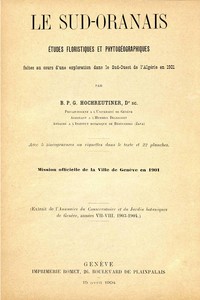
Le Sud-Oranais: études floristiques et phytogéographiques faites au cours d'une…
This book isn't a story in the traditional sense. It's a scientific expedition frozen in time. Benedict Hochreutiner was a plant scientist from Geneva who, over a century ago, packed his gear and headed into what was then French Algeria. His mission was clear: to document every plant he could find in the vast, dry expanse of the Oran region, an area touching the Sahara. The 'plot' is his journey across this challenging land. He describes the places he went, the conditions he faced, and, most importantly, the resilient life he found there. He gives us lists and descriptions of grasses, shrubs, and trees, noting exactly where and how they grow. It's a systematic, patient recording of a ecosystem few had studied in such detail.
Why You Should Read It
You should read this if you love the idea of time travel through science. Hochreutiner's writing is dry and technical, but that's part of the charm. Between the Latin plant names and soil descriptions, you get flashes of a person utterly dedicated to his task. There's a quiet drama in his fight against the environment just to complete a list. More than that, this book is a snapshot of a world that may be gone. Climate, land use, and politics have changed that landscape forever. This study is a baseline, a record of what was. It makes you think deeply about place, survival, and how we understand the natural world. It turns a seemingly barren desert into a place full of specific, struggling life.
Final Verdict
This is a niche book, but a rewarding one. It's perfect for readers who enjoy historical travelogues, amateur botanists, or anyone with a patient curiosity about the world. It's not a breezy read; it's a companion for slow afternoons. Think of it as the literary equivalent of a detailed museum exhibit. If you enjoyed the quiet observation in books like Robert Macfarlane's 'The Old Ways' or even the cataloguing spirit of 'The Guinness Book of World Records,' you'll find something special here. It's for the reader who doesn't always need a plot, just a compelling window into a forgotten journey.
This digital edition is based on a public domain text. Knowledge should be free and accessible.
Robert Wilson
9 months agoThe layout is perfect for tablet and e-reader devices.
Mary Perez
1 year agoI stumbled upon this title during my weekend research and the attention to detail regarding the core terminology is flawless. Truly a masterpiece of digital educational material.
Thomas Davis
1 year agoBefore I started my latest project, I read this and the objective evaluation of the pros and cons is very refreshing. Simple, effective, and authoritative – what else could you ask for?
Linda Davis
11 months agoTo be perfectly clear, the content flows smoothly from one chapter to the next. This story will stay with me.


Sarah Harris
11 months agoAfter a thorough walkthrough of the table of contents, the author’s unique perspective adds a fresh layer to the discussion. I am looking forward to the author's next publication.