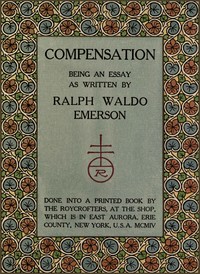
Ralph Waldo Emerson opens his essay Compensation by recalling a boyhood wish to write on the subject, because he felt that “Life was ahead of theology and the people knew more than the preachers taught.” This personal origin grounds the argument in everyday experience rather than abstract doctrine. The essay’s epigraph from Thomas Carlyle sets the tone: “there is nothing else but justice.” Emerson then rejects the notion that compensation is postponed to an afterlife, mocking the idea that saints will receive “bank-stock and doubloons, venison and champagne” as future rewards. Instead, he insists that justice operates here and now, woven into the fabric of nature and human affairs.
Everyday Evidence for a Moral Law
Emerson draws his evidence not from scripture or philosophy but from “the transactions of the street, the farm and the dwelling-house.” He lists “the greetings, the relations, the debts and credits, the influence of character” as documents from which the doctrine of compensation can be read. This method insists that moral law is as observable as a shop-bill or a foot-rule. The preacher’s sermon on a deferred judgment is dismissed because it ignores what people already know: that cause and effect operate visibly in daily life. Emerson’s language is concrete—tools, bread, baskets—and his examples are drawn from common experience, making his argument accessible and immediate.
Nature as a System of Penalties and Rewards
Emerson describes a world where “the earth is made of glass” for the criminal: no concealment is possible. He uses vivid natural imagery: a coat of snow reveals the tracks of every creature; water, snow, wind, and gravitation become penalties for the thief. Conversely, love is “mathematically just, as much as the two sides of an algebraic equation.” The good man, like fire, turns everything to his own nature. Emerson even invokes Napoleon to illustrate how enemies become friends. This section shows his characteristic blend of transcendental optimism and hard-headed observation, asserting that the universe is arranged for truth and benefit, with no hiding place for vice.
Weakness as a Source of Strength
Emerson argues that defects are often more useful than advantages. He cites the fable of the stag, whose admired horns trap him while his despised feet save him. “Every man in his lifetime needs to thank his faults,” he writes. A defect of temper may drive a person into solitude and self-reliance; like “the wounded oyster, he mends his shell with pearl.” Strength grows out of weakness, and a great man is “always willing to be little.” Emerson’s prose here is aphoristic and memorable, turning conventional wisdom on its head. He values the indignation that arises from being “pricked and stung and sorely shot at,” seeing it as the seed of secret forces.
The Paradox of Blame and Praise
Emerson makes a striking personal confession: “I hate to be defended in a newspaper.” He feels secure when attacked, but exposed when praised. This paradox extends his argument that opposition is beneficial. “Blame is safer than praise,” he asserts, because it forces self-examination. The wise man “throws himself on the side of his assailants,” more interested than they are in finding his weak point. The wound falls off “like a dead skin,” leaving him invulnerable. Emerson’s tone is confident, even combative, and his examples—from the Sandwich Islander’s belief in absorbing an enemy’s strength to the idea that resisted temptation adds to our power—reinforce his central theme: every evil not succumbed to becomes a benefactor.
Emerson’s Compensation rewards readers who attend to its concrete details and rhetorical turns. The essay’s power lies not in abstract argument but in its accumulation of homely examples and sharp reversals. Readers should watch how Emerson moves from the personal to the cosmic, and how he uses nature, trade, and daily mishap to illustrate a moral law that is immediate and inescapable. The essay is best read slowly, allowing each aphorism to resonate before moving to the next.
There’s something steadying in Emerson’s claim that balance arrives in the living moment, not after we stop looking. I thought of that while revisiting A Tramp’s Notebook, where the same quiet faith appears, worn soft by road dust. It reminded me of walking home late, noticing how every small surrender seemed to leave something gentle behind. A Tramp's Notebook — Edition Insights holds that feeling like a pocketed stone.