
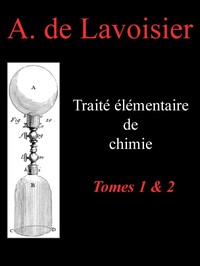
Traité élémentaire de chimie, tomes 1 & 2 by Antoine Laurent Lavoisier
Okay, let's be clear from the start: this is not a novel. There's no plot twist on page 42. But the 'story' Lavoisier tells is one of the greatest intellectual detective stories ever written.
The Story
Think of science before 1789 as a room full of brilliant people arguing in different languages. Lavoisier walks in and says, 'Everyone, stop. First, we all need to use the same words.' His Traité is that new dictionary and rulebook. Volume 1 lays down the law: he introduces his precise balance, defines elements as substances that can't be broken down further, and presents his new chemical nomenclature (oxygen, hydrogen, etc.). He demolishes the phlogiston theory—the old idea that a fire-like substance was released during burning—by proving through meticulous experiments that combustion is actually a substance (oxygen) combining with another. Volume 2 is the practical application, a detailed catalog of reactions and processes that follow his new rules.
Why You Should Read It
You should read it to witness a paradigm shift in real time. The thrill isn't in the prose style (it's very methodical), but in seeing a logical, quantitative system being built from the ground up. You see his mind at work. He's not just a theorist; he's in the lab, weighing, measuring, and questioning every assumption. It's humbling to see how much we take for granted. The idea that air is a mixture of gases, or that water is a compound, was revolutionary. Reading Lavoisier, you get the 'aha!' moment for all of modern chemistry. It makes you appreciate the sheer hard work and courage it took to tell the entire scientific establishment they were wrong.
Final Verdict
This book is a must for anyone fascinated by the history of ideas, not just science. It's perfect for the curious reader who wants to understand how we know what we know. If you enjoy biographies of great thinkers, this is like reading their primary source material. It's also great for science teachers who want to bring the story of discovery into their classrooms. Fair warning: it's an 18th-century scientific text, so parts can be slow. But skimming through, focusing on his introductions and key experiments, is incredibly rewarding. This isn't just a book about chemistry; it's the blueprint for how to think clearly about the physical world.
This digital edition is based on a public domain text. Thank you for supporting open literature.
Emily Thomas
5 months agoAs a professional in this niche, the data points used to support the main thesis are quite robust. Highly recommended for those seeking credible information.

Kimberly Johnson
1 year agoThe author provides a very nuanced critique of current methodologies.