
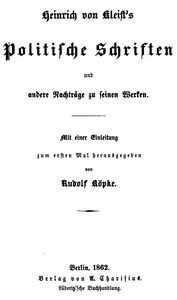
Heinrich von Kleist's politische Schriften und andere Nachträge zu seinen…
This isn't a novel with a clear beginning and end. Instead, it's a collection of Heinrich von Kleist's non-fiction work, primarily from the period between 1809 and 1811. Think of it as a time capsule from a Europe in crisis.
The Story
There isn't a single narrative. The "story" is the real-world drama Kleist was living through. Napoleon's armies had reshaped the map, and German states were under French control or influence. In response, Kleist co-founded a political newspaper, Berliner Abendblätter. The writings here—essays, articles, fragments—are his weapon. He writes fiery calls to national spirit, analyzes military strategy, and critiques the political weakness he saw around him. It's the record of a writer stepping directly into the fray, using his pen not just for art, but for a cause he believed was existential.
Why You Should Read It
Reading Kleist's political work is a revelation. It connects the dots. The famous desperation of his fictional characters—Kohlhaas's obsessive quest for justice, Penthesilea's brutal passion—makes so much more sense when you see the same fierce, uncompromising energy applied to politics. You get the sense of a man who felt everything too deeply, whether it was love, honor, or national identity. His arguments aren't dry policy; they're charged with emotion and a poetic sense of doom. It shows that his literary genius wasn't separate from his engagement with the world. It was all part of the same storm inside him.
Final Verdict
This book is perfect for anyone who loves Kleist's plays and stories and wants to understand the man behind them. It's also great for readers interested in the messy, human side of history—not just dates and battles, but how a sensitive artist experienced a time of war and upheaval. It's not a light read, but it's a fascinating and deeply personal one. You come away feeling like you've had a long, intense conversation with Kleist himself, and you won't look at his other work the same way again.
This historical work is free of copyright protections. You do not need permission to reproduce this work.
Susan Gonzalez
2 months agoA brilliant read that I finished in one sitting.
William Harris
8 months agoImpressive quality for a digital edition.
Elizabeth Martin
10 months agoI didn't expect much, but it manages to explain difficult concepts in plain English. I couldn't put it down.
Susan Allen
7 months agoAfter finishing this book, the content flows smoothly from one chapter to the next. Definitely a 5-star read.



Elizabeth Wilson
1 year agoI was particularly interested in the case studies mentioned here, the visual layout and supporting data make the reading experience very smooth. I am looking forward to the author's next publication.