About 167 minutes
Letters to Dead Authors — Text and Context
Historical Psychological Social Fiction
38,343 recorded words. 6 minutes difference from this book's estimate.
View Gutenberg source #1491
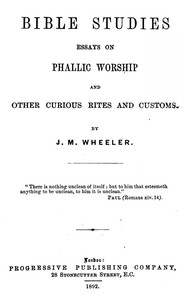
For Bible Studies: Essays on Phallic Worship and Other Curious Rites and Customs — Reading Companion, the stored edition analysis reports 39,632 words, 2 hr 53 min estimated reading time, and 5 detected text sections.
The text analysis averages about 19.9 words per sentence, while the detected sections provide another way to judge how the source is divided.
Project Gutenberg metadata also associates the work with “Phallicism,” connecting these edition facts with the source record’s subject description.
Explore this collection
These alternatives are selected using recorded categories and estimated reading time.
About 167 minutes
Historical Psychological Social Fiction
38,343 recorded words. 6 minutes difference from this book's estimate.
View Gutenberg source #1491About 188 minutes
Historical Psychological Social Fiction
43,181 recorded words. 15 minutes difference from this book's estimate.
View Gutenberg source #67775About 198 minutes
Historical Psychological Social Fiction
45,510 recorded words. 25 minutes difference from this book's estimate.
View Gutenberg source #15687Search stored excerpts and compare books → Choose by your preferences →
Choices use stored catalog measurements. Estimates vary with reading speed. A shared category is a catalog label, not a claim that two books have the same argument or literary quality.
Search reads excerpt text stored with this catalog and links to its associated Gutenberg record. The connection is stored in the site database; this tool does not recheck that every excerpt is word-for-word identical to that external record. Excerpt search does not cover every chapter and does not verify historical publication dates.
Catalog snapshot checked: 2026-09-25. Coverage: 93 public books, 92 available source excerpts.
Read the complete public-domain text at its original source.
Read on Project GutenbergJ. M. Wheeler's Bible Studies opens with a preface by G. W. Foote, who describes the work as a 'little craft' built to weather criticism, and positions Wheeler as an evolutionist reading Jewish scriptures in light of anthropology. The preface explicitly states the book's aim: to show 'what religious ideas, rites, and customs prevailed among the ancient Jews.' This framing immediately signals that the essays will treat the Bible as a source of primitive practices rather than divine revelation. The first excerpt on the trial of jealousy (Numbers 5) illustrates this method: Wheeler juxtaposes the biblical ordeal with parallel customs from Cape Breton and African tribes, drawing on sources like Dr. Kitto and Dr. Livingstone. This comparative approach, grounded in 19th-century anthropology, defines the book's structure and argumentative strategy.
The preface, written by Foote, is more than a commendation; it outlines the book's intellectual framework. Foote notes that Wheeler's mind is 'given to a different study'—not literary or scientific criticism, but an anthropological reading that finds 'infinite illustrations' of the 'savage origin of religion.' This sets expectations: the essays will not debate theology or historicity but will treat biblical passages as ethnographic data. Foote's metaphor of Wheeler gathering 'like the summer bee' to yield 'pure honey of truth' suggests a compilation of facts rather than original argument. For a first reader, this preface is essential for understanding that each essay will likely follow a pattern: present a biblical custom, then compare it to non-biblical parallels to argue for a common primitive origin.
The excerpt on the trial of jealousy (Numbers 5) exemplifies Wheeler's method. He describes the biblical ordeal where a woman suspected of adultery drinks 'holy water' that causes physical harm if she is guilty. Wheeler then cites a similar custom from Cape Breton, where a bride eats meat that would poison her if unfaithful, and African 'red water' ordeals described by Dr. Kitto and Dr. Livingstone. The structure is consistent: biblical text, ethnographic parallel, and a critical comment. Wheeler notes that the Jewish law lacks provision for a woman accusing her husband, highlighting gender asymmetry. He also observes that the ordeal relies on 'superstitious fear,' a phrase that recurs in his analysis. This section shows how Wheeler uses external sources to frame biblical practices as barbaric, a tone that persists throughout the essays.
Across the excerpts, Wheeler employs several recurring tactics. He frequently cites contemporary anthropologists like Dr. Tylor and Dr. Livingstone to lend authority. He uses the phrase 'absurdity and atrocity' to characterize biblical laws, as seen in his comment on the trial of jealousy: 'The absurdity and atrocity of this divine law only finds its parallel in the customs of the worst barbarians.' This rhetorical move equates biblical practices with those of 'savages,' a term common in 19th-century anthropology. Wheeler also draws on Jewish commentators like Maimonides to show internal criticism. The essays are dense with footnotes and references, creating an impression of scholarly rigor. Readers should expect each essay to follow a similar pattern: a biblical passage, comparative ethnographic evidence, and a concluding judgment that emphasizes the primitive nature of the rite.
The table of contents lists 19 essays, from 'Phallic Worship Among the Jews' to 'Sacred Seven,' suggesting a thematic rather than sequential argument. The excerpts provided focus on the trial of jealousy, but the preface indicates that other essays cover circumcision, blood rites, scapegoats, and witchcraft. The inclusion of illustrations (e.g., the Hindu linga-yoni, the Asherah) hints at visual evidence. The book's word count (39,632 words) suggests each essay is relatively short, likely 2,000–3,000 words. The preface's claim that the essays are 'selected' from Wheeler's broader work implies that this collection is curated to highlight his anthropological approach. For a first reading, the preface and the first essay on phallic worship would establish the book's tone and method, while later essays on specific topics can be read independently.
Wheeler's Bible Studies is best approached as a series of case studies rather than a unified thesis. The preface provides the key: read each essay as an exercise in comparative anthropology, where biblical rites are placed alongside customs from Africa, India, and ancient Europe. The excerpts show that Wheeler's evidence is drawn from 19th-century sources, and his judgments reflect the evolutionary assumptions of his time. Readers interested in the history of biblical criticism or the development of anthropological method will find this work a valuable primary source, but those seeking theological insight should look elsewhere.
I keep returning to that Reading Companion, fascinated by how Wheeler’s fragments illuminate the darker corners of old rites. It stirred a quieter memory of The collected works of William Hazlitt, Vol. 05 (of 12) — Themes and Context, where his essays drift through similar obsessions—yet with a warmth that softens the strangeness. Certain pages felt like old conversations, gently unfinished.
Save your reaction, strongest insight, and memorable passage.









