
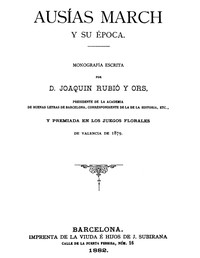
Ausías March y su época by Joaquín Rubió y Ors
Let's be clear from the start: this isn't a beach read. But if you're curious about how history gets written and why certain figures are rescued from obscurity, it's a surprisingly gripping journey. The book sits at a unique crossroads—it's about a medieval poet, written with the passion of a 19th-century revivalist.
The Story
There isn't a traditional narrative. Instead, Joaquín Rubió y Ors builds a case. He introduces us to Ausiàs March, a knight and landowner from Valencia who, in the 1400s, wrote poetry of shocking emotional depth. He didn't write about chivalry or idealized love; he wrote about doubt, jealousy, the pain of love, and the fear of God with a stark, almost modern honesty. Rubió y Ors then walks us through March's world—the politics of the Crown of Aragon, the social structures—to contextualize this brilliant, troubled voice. The second layer of the 'story' is Rubió y Ors's own project: collecting, studying, and championing March's work as a cornerstone of Catalan literary heritage during the Renaixença, a period of cultural rebirth.
Why You Should Read It
You read this for the double vision. On one page, you're grappling with March's profound, gloomy verses about the human condition. On the next, you feel the urgency of Rubió y Ors, a scholar trying to rebuild a cultural identity brick by brick, using poetry as his foundation. It makes you think: how many other brilliant voices have been sidelined by history? The book is a powerful reminder that literature isn't just created; it's also curated. Someone has to fight for it. The passion is palpable, and it transforms what could be a dry academic subject into something alive and contentious.
Final Verdict
This is a niche but rewarding pick. It's perfect for readers who love literary history, or anyone interested in the cultural movements of 19th-century Europe. If you enjoy seeing how a single figure can be used to tell a much larger story about language, identity, and national pride, you'll find this compelling. It's also great if you just want to discover an incredible poet you probably never learned about in school. Approach it not as a straightforward biography, but as a document of rediscovery, and you'll be fascinated.
The copyright for this book has expired, making it public property. It serves as a testament to our shared literary heritage.
Joseph King
5 months agoAfter hearing about this author multiple times, it manages to explain difficult concepts in plain English. Thanks for sharing this review.
Sarah Miller
1 year agoI stumbled upon this title and the storytelling feels authentic and emotionally grounded. Definitely a 5-star read.
Ashley Clark
2 years agoThanks for the recommendation.
Anthony Wilson
7 months agoTo be perfectly clear, the character development leaves a lasting impact. Exceeded all my expectations.




Kimberly Jackson
2 months agoA brilliant read that I finished in one sitting.