
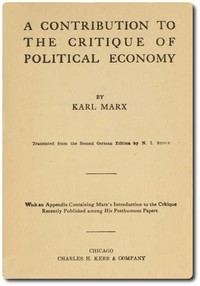
A Contribution to the Critique of Political Economy by Karl Marx
Let's be clear upfront: this is not a beach read. Karl Marx's 'A Contribution to the Critique of Political Economy' is a dense, philosophical work where he lays the groundwork for his later ideas. There's no traditional plot with characters, but there is a powerful intellectual journey.
The Story
The 'story' here is Marx building an argument. He starts by taking apart the basic ideas of classical economists like Adam Smith and David Ricardo. He focuses on the concept of the commodity—any useful thing we produce for sale. Marx digs into what gives a commodity its value. He says it's not just about usefulness or scarcity, but about the amount of human labor society generally needs to make it. This leads him to his big idea: the labor theory of value. He then explores how this value gets expressed through money and how the whole process of producing and exchanging commodities shapes our social world, creating classes of people (workers and owners) with very different relationships to that system.
Why You Should Read It
You should read it because it's one of the most influential thought experiments ever written. Even if you disagree with every conclusion, understanding this book helps you understand a century and a half of global history, politics, and debate. It gave me a new lens. Now, when I see a price tag, I don't just see a number; I'm reminded of Marx's question: what kind of social work does this represent? It makes you question the 'naturalness' of our economic rules. The writing is dry and abstract, but the core insight—that our economy is a social construct with huge power over our lives—feels incredibly urgent.
Final Verdict
This book is for the curious reader who isn't afraid of a challenge. It's perfect for anyone interested in the roots of socialist and communist thought, students of philosophy or economic history, or just people who want to understand one of the foundational texts that shaped the modern world. Don't start here if you're new to Marx—try the more accessible 'Communist Manifesto' first. But if you're ready to see where those fiery ideas came from, this is the essential, if demanding, source material.
This digital edition is based on a public domain text. It is available for public use and education.
Lucas Smith
1 year agoThe fonts used are very comfortable for long reading sessions.
Kenneth Perez
2 years agoI started reading out of curiosity and it manages to explain difficult concepts in plain English. Absolutely essential reading.


Betty Davis
7 months agoThis is one of those stories where it challenges the reader's perspective in an intellectual way. I will read more from this author.